
.png)
Classification of Houses in Astrology: Kendra, Trikona, Upachaya & Dusthana


Classification of Houses in Astrology
When you start learning astrology, understanding planets and houses is only the beginning. There are 12 houses in a birth chart, and each house represents different aspects of life and their Karak Tatva (natural significations) in Vedic astrology. These houses are further grouped into different categories based on their nature and role in a horoscope.
These classifications help an astrologer understand the basic strength and nature of a house. But a house should never be judged only by its category. The house lord, its placement, planetary aspects, conjunctions, Nakshatra, degree, dignity, and other influences can all change the final result.
For example, a Kendra lord placed in an Upachaya, Trikona, or Dusthana house can give a different result depending on the planet and the rest of the horoscope. Similarly, a planet placed in a Kendra may not always give the same result if it is influenced by another planet.
This is why house classification is a starting point for chart analysis, not the final prediction.
Kendra Houses in Astrology
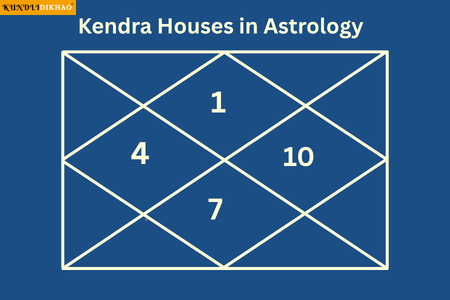
The 1st, 4th, 7th, and 10th houses are called Kendra houses. They are often described as the main pillars of a birth chart because they represent some of the most important areas of life.
1st House – Self, personality, health and overall life
4th House – Home, mother, property, education and emotional happiness
7th House – Marriage, spouse, partnerships and public dealings
10th House – Career, profession, reputation and status
Kendra houses are important, but simply having a planet in a Kendra does not automatically make its results positive. We also need to see which planet it is, what houses it owns, where its dispositor is placed, which planets influence it, and how strong it is.
Example
Suppose the 10th lord is placed in the 4th house. The 10th house represents career and the 4th represents home, property, education and inner security. This can connect career with these areas of life. But the actual result will depend on the planet, its dignity, degree, Nakshatra, aspects and the condition of both the 4th and 10th houses. So we should not stop at: "10th lord is in 4th house."
We need to ask:
Which 10th lord? In which sign? At what degree? In which Nakshatra? Who aspects it? Is it strong or weak? What is happening to the 4th house and its lord?
That is where actual chart reading begins.
Trikona Houses in Astrology
The 1st, 5th, and 9th houses are called Trikona houses. These houses are connected with dharma, intelligence, knowledge, creativity, fortune and personal growth.
1st House – Self and life direction
5th House – Intelligence, education, creativity, children and past-life merit
9th House – Luck, higher education, father, guru, spirituality and dharma
The 5th and 9th houses are particularly important when analysing fortune, knowledge and blessings in a horoscope.

Example
Suppose the 5th lord is strongly connected with the 9th lord. This can create a connection between intelligence, education, creativity, fortune and higher learning. But again, we cannot simply call the combination "good" without checking the planets involved.
For example, a Trikona lord placed in a Dusthana house may have to work through challenges before giving its results. Its strength, sign, Nakshatra, aspects and Dasha will tell us much more about how that placement will actually work.
Upachaya Houses in Astrology
The 3rd, 6th, 10th and 11th houses are called Upachaya houses.
Upachaya means growth or increase. These houses are connected with areas where results can develop through effort, experience, competition and time.
3rd House – Courage, communication, skills and younger siblings
6th House – Competition, service, debts, enemies and health challenges
10th House – Career, profession and achievements
11th House – Income, gains, networks and fulfilment of desires
This is why a difficult planet can sometimes give useful results in an Upachaya house. The challenges represented by the planet may push a person to become stronger and more capable.

Example
If the 10th lord is placed in the 3rd house, career may become connected with communication, writing, sales, business skills, courage or self-effort. But we still need to check the condition of the 10th lord. A strong planet in a favourable sign and Nakshatra may give a very different result from the same planet when weak or heavily afflicted. So Upachaya does not mean "everything will automatically become good." It means the area can develop through effort and experience.
Dusthana Houses in Astrology
The 6th, 8th and 12th houses are known as Dusthana houses. These houses are generally associated with challenges, obstacles, changes, losses and situations that require adjustment.
6th House – Disease, debt, competition, enemies and service
8th House – Longevity, sudden changes, inheritance, research and transformation
12th House – Expenses, foreign lands, isolation, spirituality and Moksha
However, calling these houses simply "bad" would be misleading.
For example, the 8th house can bring sudden changes, but it is also important for research, occult subjects, investigation and transformation. The 12th house can show expenses and isolation, but it can also support foreign connections, meditation, spirituality and detachment.

Example
If an 11th lord is placed in the 6th house, we have a connection between gains and the 6th house.
The 6th is both a Dusthana and an Upachaya. Therefore, the placement should not be judged only as negative.
It may connect income or gains with areas such as service, employment, competition, problem-solving or overcoming obstacles. But the actual outcome depends on the planet, its strength, sign, Nakshatra, aspects, Dasha and the condition of the houses involved.
Maraka Houses in Astrology
The 2nd and 7th houses are traditionally known as Maraka houses. Maraka is mainly considered in longevity and serious health-related analysis. It does not mean that having a planet in the 2nd or 7th house automatically indicates something negative.
2nd House – Wealth, family, speech and accumulated resources
7th House – Marriage, spouse, partnerships and one-to-one relationships
Example
If a Maraka lord is running in a Dasha, we cannot immediately predict a serious event. An astrologer would first examine the Ascendant, 8th house, longevity factors, relevant planets, Dashas, Nakshatras and transits before reaching any conclusion. This is an important point for beginners: one placement is never enough to make a serious prediction.
One House Can Belong to More Than One Group
This is where house classification becomes interesting.
A house can belong to more than one category.
For example:
1st House → Kendra + Trikona
6th House → Upachaya + Dusthana
10th House → Kendra + Upachaya
7th House → Kendra + Maraka
So when you see that a house belongs to two different groups, don't think that one classification cancels the other. Instead, both qualities have to be considered.
For example, the 6th house is both Dusthana and Upachaya. It can show disease, debt and competition, but it is also a house where a person can become stronger through effort and experience.
How Planetary Placement Changes the Result
This is one of the most important things to understand when learning astrology. Suppose a Kendra lord is placed in an Upachaya house. We cannot simply say that the placement is good or bad because of the two classifications.
We need to look at:
Which planet is the Kendra lord?
Which house is it placed in?
Which sign is it in?
Is the sign friendly or hostile to the planet?
What is the planet's degree?
Which Nakshatra is it placed in?
What is the condition of its Nakshatra lord?
Which planets are aspecting it?
Is it conjunct another planet?
Is it placed in a Dusthana or Upachaya?
Is it a Badhak or Akarak planet for that particular Lagna?
What Dashas are operating?
Only after looking at these factors can we understand how the placement may actually work.
The same rule applies to a planet placed in a Kendra. A planet in a Kendra does not automatically give positive results. Another planet's conjunction or aspect can significantly change its expression.
This is why two people can have the same planet in the same house and still experience very different results.
A Practical Kundli Example
Let's take an example to understand this better.

In this example chart, the Ascendant is Pisces.
10th Lord Jupiter in the 4th House
For Pisces Ascendant, Jupiter rules the 1st and 10th houses. Jupiter is placed in the 4th house in Gemini, along with Mars.
The 10th house represents career, while the 4th house represents home, property, education, mother and inner happiness. So the 10th lord's placement in the 4th creates a connection between career and 4th-house matters. But we don't stop there. Jupiter is around 3°08' Gemini and is placed in Mrigashira Nakshatra. Mars is also in the 4th house at around 29°16' Gemini, in Punarvasu Nakshatra.
Now we have to consider the relationship between Jupiter and Mercury because Mercury rules Gemini, the sign where Jupiter is placed. Mercury itself is placed in the 1st house with Venus and Ketu. So the chain of analysis becomes: 10th lord Jupiter → 4th house → Gemini → Mercury → Mercury in the 1st house. This gives us much more information than simply saying: "The 10th lord is in the 4th house." This is how house classification and planetary placement work together in an actual horoscope.
What can this mean for the native?
This combination can make career and professional decisions closely connected with education, communication, knowledge, property, home or the need for emotional security. Jupiter's connection with the 1st house can also make career an important part of the native's identity and life direction.
Jupiter aspects the 8th, 10th and 12th houses. Its aspect on the 10th house is particularly relevant because the 10th lord is also influencing its own house. This can strengthen the importance of career and professional development in the native's life.
However, Jupiter is placed in Mercury's sign, so the condition of Mercury, the dispositor, becomes important. Mercury is placed in the Ascendant with Venus and Ketu. Therefore, we cannot judge Jupiter's result independently. The lesson here is simple: a 10th lord in a Kendra may support career, but the final result depends on the planet's sign, strength, Nakshatra, aspects and the condition of its dispositor.
2. 11th Lord Saturn in the 6th House
In this chart, Saturn rules the 11th and 12th houses and is placed in the 6th house in Leo. The 11th house represents income, gains, fulfilment of desires and networks, while the 6th house represents service, employment, competition, debts, enemies and challenges. The interesting part is that the 6th house is both an Upachaya and a Dusthana. Saturn is placed at around 1°49' in Magha Nakshatra.
What can this mean for the native?
This placement can connect gains and income with service, employment, competition, problem-solving and overcoming difficult situations. The native may have to work hard for gains rather than receiving everything easily. However, because the 6th is an Upachaya house, the ability to handle competition, responsibilities and professional challenges can improve with age and experience.
Saturn's nature also supports patience and persistence, so results may develop gradually rather than suddenly.
But there is another important factor: Saturn is in Leo, ruled by the Sun, and the Sun is the 6th lord placed in the 12th house. Therefore, the condition of the Sun also becomes relevant to understanding how this Saturn placement will operate. So we cannot simply say: "The 11th lord is in the 6th, therefore it is bad." The actual interpretation is much more layered.
3. 6th Lord Sun in the 12th House
The Sun is the 6th lord for Pisces Ascendant and is placed in the 12th house in Aquarius, at around 27°34' in Purva Bhadrapada Nakshatra. Here we have a connection between two Dusthana houses:
6th house → 12th house
The 6th represents work, service, competition, debts and health challenges, while the 12th represents expenses, foreign lands, isolation, sleep, spirituality and letting go.
What can this mean for the native?
This placement can connect the native's work or responsibilities with foreign places, large institutions, hospitals, behind-the-scenes work, or situations requiring isolation or service, depending on the profession and other chart factors.
It can also show that expenses or responsibilities may sometimes arise through 6th-house matters.
At the same time, the Sun's placement in the 12th can make the native more comfortable with working behind the scenes rather than always seeking the spotlight. The final result would depend on the strength of the Sun, its Nakshatra, aspects, Dasha and its connection with other houses.
4. Mercury, Venus and Ketu in the 1st House
The 1st house contains Mercury, Venus and Ketu. This is another excellent example of why simply saying "a planet is in a Kendra, so it will give good results" is not enough.
For Pisces Ascendant:
Mercury rules the 4th and 7th houses
Venus rules the 3rd and 8th houses
Ketu is placed with them in the Ascendant
Mercury is around 9°26' Pisces, Venus around 9°25' Pisces, and Ketu around 12°35' Pisces.
What can this mean for the native?
The 1st house represents personality, appearance, approach to life and overall direction. With Mercury and Venus here, communication, creativity, relationships, learning and interaction with others can become important parts of the personality. Venus is exalted in Pisces, which can add a refined, creative, imaginative or artistic quality.
But Mercury is debilitated in Pisces, and it is also the 7th lord and Badhak lord for a dual-sign Ascendant. Its close conjunction with exalted Venus and Ketu means its result cannot be judged from debilitation alone. The exact degrees also matter because Mercury and Venus are almost at the same degree, making their conjunction particularly close.
Ketu adds another layer and can make the native's approach to relationships, identity or personal expression more unusual, detached or difficult to explain in simple terms.
This is a good example of why sign + lordship + dignity + degree + conjunction + Nakshatra + house classification must all be considered together.
Notice what happened in these examples: We did not decide the result simply by seeing whether a house was Kendra, Trikona, Upachaya or Dusthana. We checked the house lord, its placement, sign, degree, Nakshatra, planetary relationships, aspects, conjunctions and functional role for the Ascendant. This is how a house classification becomes useful in actual Kundli reading.
Why Aspects and Nakshatras Matter
A planet's placement is only one part of the picture. For example, a planet may be placed in a favourable house, but if it receives a difficult planetary influence, the result can change. Similarly, a planet may be in a challenging house but receive supportive influences that modify its results.
The Nakshatra also adds another layer to the interpretation.
This is why we don't read:
House → fixed result.
Instead, we look at:
House + Lordship + Sign + Degree + Nakshatra + Strength + Conjunction + Aspects + Dasha + Gochar
and then interpret the chart as a whole.
The Real Purpose of House Classification
House classification is not about putting houses into boxes labelled "good" and "bad." It gives an astrologer a framework for understanding how different areas of life may function and where growth, opportunity, challenge or change may come from. The real interpretation starts when these classifications are combined with planetary placement, lordship, strength, Nakshatra, aspects and timing. That is why reading a Kundli is much more than looking at one planet or one house.
A Simple Way to Understand House Classification
Kendra, Trikona, Upachaya, Dusthana and Maraka classifications give us a useful starting point when reading a Kundli. But they are only one part of the analysis. The result of a house depends on its lord, planetary placement, sign, degree, Nakshatra, aspects, conjunctions, strength and the Dasha and Gochar operating at that time. So rather than asking whether a house is simply good or bad, it is better to ask: How is this house functioning in this particular Kundli? That is what makes every birth chart different.
Want to understand how these house classifications work in your own Kundli? A complete chart reading looks at your houses, planets, Dashas and Gochar together.
Want to understand what each of the 12 houses represents? Read our guide to 12 Houses in Astrology.
Frequently Asked Questions
What are the main classifications of houses in astrology?
The main classifications are Kendra, Trikona, Upachaya, Dusthana and Maraka houses. Each group has a different role in horoscope analysis.
Which houses are Kendra houses?
The 1st, 4th, 7th and 10th houses are Kendra houses. They are considered the main pillars of a horoscope.
Which houses are Trikona houses?
The 1st, 5th and 9th houses are Trikona houses. They are associated with dharma, knowledge, intelligence, fortune and personal growth.
Which houses are Upachaya houses?
The 3rd, 6th, 10th and 11th houses are Upachaya houses. These areas can develop through effort, experience and time.
Which houses are Dusthana houses?
The 6th, 8th and 12th houses are known as Dusthana houses. They can show challenges, obstacles, changes, expenses and transformation.
Which houses are Maraka houses?
The 2nd and 7th houses are traditionally called Maraka houses. Their role is mainly considered in specific longevity and serious health-related analysis.
Can one house belong to more than one category?
Yes. For example, the 1st house is both Kendra and Trikona, while the 6th house is both Upachaya and Dusthana.
Does a planet in a Kendra always give good results?
No. The result depends on the planet's lordship, strength, sign, degree, Nakshatra, conjunctions, aspects and other factors in the horoscope.


Comments